
Keyword: 多変量時系列, 多入力モデル, 推定
概要
本サンプルは時系列モデルの推定の計算を行うC言語によるサンプルプログラムです。 本サンプルは以下に示される時系列データを分析し、時系列モデルの推定値を出力します。
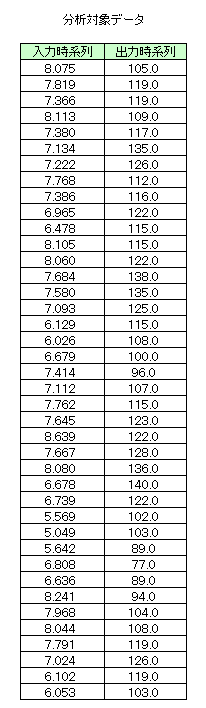
※本サンプルはnAG Cライブラリに含まれる関数 nag_tsa_multi_inp_model_estim() のExampleコードです。本サンプル及び関数の詳細情報は nag_tsa_multi_inp_model_estim のマニュアルページをご参照ください。
ご相談やお問い合わせはこちらまで
入力データ
(本関数の詳細はnag_tsa_multi_inp_model_estim のマニュアルページを参照)| このデータをダウンロード |
nag_tsa_multi_inp_model_estim (g13bec) Example Program Data
 40    2    20
    1    0    0    0    0    1    4
    1
    0
    1
    3
0.0       0.0       2.0       0.5       0.0
     8.075     105.0
     7.819     119.0
     7.366     119.0
     8.113     109.0
     7.380     117.0
     7.134     135.0
     7.222     126.0
     7.768     112.0
     7.386     116.0
     6.965     122.0
     6.478     115.0
     8.105     115.0
     8.060     122.0
     7.684     138.0
     7.580     135.0
     7.093     125.0
     6.129     115.0
     6.026     108.0
     6.679     100.0
     7.414      96.0
     7.112     107.0
     7.762     115.0
     7.645     123.0
     8.639     122.0
     7.667     128.0
     8.080     136.0
     6.678     140.0
     6.739     122.0
     5.569     102.0
     5.049     103.0
     5.642      89.0
     6.808      77.0
     6.636      89.0
     8.241      94.0
     7.968     104.0
     8.044     108.0
     7.791     119.0
     7.024     126.0
     6.102     119.0
     6.053     103.0
- 1行目はタイトル行で読み飛ばされます。
- 2行目に時系列データの数(nxxy)、入力時系列、出力時系列の合計数(nseries)、最大反復数(max_iter)を指定しています。
- 3行目はARIMAモデルの次数ベクトル(自己回帰の数p、非季節階差の次数d、移動平均q、季節自己回帰bigp、季節階差の次数bigd、季節移動平均bigqと季節期間s)を指定しています。
- 4~7行目は伝達関数モデルの次数(transfv)を指定しています。
- 8行目は多入力モデルの引数(para)を指定しています。
- 9~48行目に入力時系列と出力時系列の値(xxy)を指定しています。
出力結果
(本関数の詳細はnag_tsa_multi_inp_model_estim のマニュアルページを参照)| この出力例をダウンロード |
nag_tsa_multi_inp_model_estim (g13bec) Example Program Results

Parameters to g13bec
____________________

nseries......................   2

criteria............ Nag_Marginal    cfixed................. Nag_FALSE
alpha..................  1.00e-02    beta...................  1.00e+01
delta..................  1.00e+03    gamma..................  1.00e-07
print_level... Nag_Soln_Iter_Full
outfile................    stdout

Iter =  -1     Residual =   6.456655e+03     Objf =   7.097184e+03

phi                     0.000000e+00
stheta                  0.000000e+00
omega      series   1   2.000000e+00
delta      series   1   5.000000e-01
constant                8.688399e+01

Iter =   0     Residual =   5.802775e+03     Objf =   6.378435e+03

phi                     0.000000e+00
stheta                  0.000000e+00
omega      series   1   2.000000e+00
delta      series   1   5.000000e-01
constant                8.573272e+01

Iter =   1     Residual =   2.354664e+03     Objf =   2.498647e+03

phi                     6.589153e-01
stheta                  6.571389e-02
omega      series   1   3.721182e+00
delta      series   1   5.237968e-01
constant                5.739128e+01

Iter =   2     Residual =   1.922339e+03     Objf =   2.032375e+03

phi                     6.417690e-01
stheta                 -2.361191e-01
omega      series   1   4.523132e+00
delta      series   1   5.742824e-01
constant                3.814856e+01

Iter =   3     Residual =   1.530797e+03     Objf =   1.630603e+03

phi                     5.550797e-01
stheta                 -3.097333e-01
omega      series   1   7.697297e+00
delta      series   1   7.358370e-01
constant               -9.322197e+01

Iter =   4     Residual =   1.232926e+03     Objf =   1.324116e+03

phi                     3.698329e-01
stheta                 -2.145294e-01
omega      series   1   9.116523e+00
delta      series   1   6.923742e-01
constant               -9.985550e+01

Iter =   5     Residual =   1.200813e+03     Objf =   1.289272e+03

phi                     3.889281e-01
stheta                 -2.649652e-01
omega      series   1   8.906746e+00
delta      series   1   6.659905e-01
constant               -7.782515e+01

Iter =   6     Residual =   1.197922e+03     Objf =   1.286734e+03

phi                     3.752731e-01
stheta                 -2.499956e-01
omega      series   1   8.957172e+00
delta      series   1   6.616140e-01
constant               -7.656262e+01

Iter =   7     Residual =   1.197934e+03     Objf =   1.286623e+03

phi                     3.804046e-01
stheta                 -2.594526e-01
omega      series   1   8.954182e+00
delta      series   1   6.599012e-01
constant               -7.553429e+01

Iter =   8     Residual =   1.198009e+03     Objf =   1.286613e+03

phi                     3.807082e-01
stheta                 -2.567453e-01
omega      series   1   8.956063e+00
delta      series   1   6.597438e-01
constant               -7.549190e+01

Iter =   9     Residual =   1.197988e+03     Objf =   1.286612e+03

phi                     3.808772e-01
stheta                 -2.580559e-01
omega      series   1   8.955983e+00
delta      series   1   6.596508e-01
constant               -7.543851e+01

Iter =  10     Residual =   1.198002e+03     Objf =   1.286611e+03

phi                     3.809218e-01
stheta                 -2.575832e-01
omega      series   1   8.956106e+00
delta      series   1   6.596484e-01
constant               -7.544005e+01

Iter =  11     Residual =   1.197997e+03     Objf =   1.286611e+03

phi                     3.809235e-01
stheta                 -2.577863e-01
omega      series   1   8.956084e+00
delta      series   1   6.596411e-01
constant               -7.543552e+01


The number of iterations carried out is   11

The final values of the parameters and their standard deviations are

   i            para[i]                 sd
   1            0.380924            0.166379
   2           -0.257786            0.178178
   3            8.956084            0.948061
   4            0.659641            0.060239
   5          -75.435521           33.505341


The residual sum of squares =     1.197997e+03

The objective function =     1.286611e+03

The degrees of freedom =    34.00

The correlation matrix is

    1.0000    -0.1839    -0.1775    -0.0340     0.1394
   -0.1839     1.0000     0.0518     0.2547    -0.2860
   -0.1775     0.0518     1.0000    -0.3070    -0.2926
   -0.0340     0.2547    -0.3070     1.0000    -0.8185
    0.1394    -0.2860    -0.2926    -0.8185     1.0000

The residuals and the z and n values are

   i         res[i]          z(t)        noise(t)

   1          0.397        180.567         -75.567
   2          3.086        191.430         -72.430
   3         -2.818        196.302         -77.302
   4         -9.941        195.460         -86.460
   5         -5.061        201.594         -84.594
   6         14.053        199.076         -64.076
   7          2.624        195.211         -69.211
   8         -5.823        193.450         -81.450
   9         -2.147        197.179         -81.179
  10         -0.216        196.217         -74.217
  11         -2.517        191.812         -76.812
  12          7.916        184.544         -69.544
  13          1.423        194.322         -72.322
  14         11.936        200.369         -62.369
  15          5.117        200.990         -65.990
  16         -5.672        200.468         -75.468
  17         -5.681        195.763         -80.763
  18         -1.637        184.025         -76.025
  19         -1.019        175.360         -75.360
  20         -2.623        175.492         -79.492
  21          3.283        182.162         -75.162
  22          6.896        183.857         -68.857
  23          5.395        190.797         -67.797
  24          0.875        194.327         -72.327
  25         -4.153        205.558         -77.558
  26          6.206        204.261         -68.261
  27          4.208        207.104         -67.104
  28         -2.387        196.423         -74.423
  29        -11.803        189.924         -87.924
  30          6.435        175.158         -72.158
  31          1.342        160.761         -71.761
  32         -4.924        156.575         -79.575
  33          4.799        164.256         -75.256
  34         -0.074        167.783         -73.783
  35         -6.023        184.483         -80.483
  36         -6.427        193.055         -85.055
  37         -2.527        199.390         -80.390
  38          2.039        201.302         -75.302
  39          0.243        195.695         -76.695
  40         -3.166        183.738         -80.738
- 6行目に適用されている時系列の数が出力されています。
- 8~12行目には以下に示すプログラムのオプション引数が出力されています。
criteria 推定基準の尤度オプション。"Nag_Marginal"は周辺尤度を意味します。 cfixed 定数 c を初期値に固定されたままにするか推定するかを指定します。"Nag_FALSE"は推定されることを意味します。 alpha 検索処理の大きさを抑制するのに使用される値。 beta alphaの値を調節する乗数。 delta 定常性や変換性のテストの許容値。 gamma 収束基準。 print_level 結果出力のレベル。"Nag_Soln_Iter_Full"は配列パラメータの各引数の説明と値が出力されることを意味します。 outfile 結果が出力されるファイル名。 - 14~116行目には各反復ごとの残差、目的関数値、ファイ、シータ、オメガ、デルタ、定数が出力されています。
- 120行目には実行した反復数が出力されています。
- 122~129行目にはパラメータの最終値と標準偏差が出力されています。
- 132行目には残差平方和が出力されています。
- 134行目には目的関数値が出力されています。
- 136行目には自由度が出力されています。
- 138から144行目には相関行列が出力されています。
- 146~189行目には残差、Z値、ノイズが出力されています。
ソースコード
(本関数の詳細はnag_tsa_multi_inp_model_estim のマニュアルページを参照)
※本サンプルソースコードはnAG数値計算ライブラリ(Windows, Linux, MAC等に対応)の関数を呼び出します。
サンプルのコンパイル及び実行方法
| このソースコードをダウンロード |
/* nag_tsa_multi_inp_model_estim (g13bec) Example Program.
*
* CLL6I261D/CLL6I261DL Version.
*
* Copyright 2017 Numerical Algorithms Group.
*
* Mark 26.1, 2017.
*/
#include <nag.h>
#include <stdio.h>
#include <string.h>
#include <nag_string.h>
#include <nag_stdlib.h>
#include <nagg13.h>
#define XXY(I, J) xxy[(I) *tdxxy + J]
int main(void)
{
Integer exit_status = 0;
Integer i, inser, j, npara, nseries, nxxy, tdxxy;
Nag_ArimaOrder arimav;
Nag_G13_Opt options;
Nag_TransfOrder transfv;
double df, objf, *para = 0, rss, *sd = 0, *xxy = 0;
NagError fail;
INIT_FAIL(fail);
printf("nag_tsa_multi_inp_model_estim (g13bec) Example Program Results\n");
scanf(" %*[^\n]"); /* Skip heading in data file */
#define CM(I, J) options.cm[(J)+(I) *options.tdcm]
#define ZT(I, J) options.zt[(J)+(I) *options.tdzt]
/*
* Initialize the option structure.
*/
/* nag_tsa_options_init (g13bxc).
* Initialization function for option setting
*/
nag_tsa_options_init(&options);
scanf("%ld%ld%ld", &nxxy, &nseries,
&options.max_iter);
if (nxxy > 0 && nseries > 0) {
/*
* Set some specific option variables to the desired values.
*/
options.criteria = Nag_Marginal;
options.print_level = Nag_Soln_Iter_Full;
/*
* Allocate memory to the arrays in structure transfv containing
* the transfer function model orders of the input series.
*/
/* nag_tsa_transf_orders (g13byc), see above. */
nag_tsa_transf_orders(nseries, &transfv, &fail);
/*
* Read the orders vector of the ARIMA model for the output noise
* component into structure arimav.
*/
scanf("%ld%ld%ld%ld%ld"
"%ld%ld", &arimav.p, &arimav.d, &arimav.q,
&arimav.bigp, &arimav.bigd, &arimav.bigq, &arimav.s);
/*
* Read the transfer function model orders of the input series into
* structure transfv.
*/
inser = nseries - 1;
for (j = 0; j < inser; ++j)
scanf("%ld", &transfv.b[j]);
for (j = 0; j < inser; ++j)
scanf("%ld", &transfv.q[j]);
for (j = 0; j < inser; ++j)
scanf("%ld", &transfv.p[j]);
for (j = 0; j < inser; ++j)
scanf("%ld", &transfv.r[j]);
npara = 0;
for (i = 0; i < inser; ++i)
npara = npara + transfv.q[i] + transfv.p[i];
npara = npara + arimav.p + arimav.q + arimav.bigp + arimav.bigq + nseries;
if (npara >= 1) {
if (!(para = nAG_ALLOC(npara, double)) ||
!(sd = nAG_ALLOC(npara, double)) ||
!(xxy = nAG_ALLOC(nxxy * nseries, double)))
{
printf("Allocation failure\n");
exit_status = -1;
goto END;
}
tdxxy = nseries;
for (i = 0; i < npara; ++i)
scanf("%lf", ¶[i]);
for (i = 0; i < nxxy; ++i)
for (j = 0; j < nseries; ++j)
scanf("%lf", &XXY(i, j));
/* nag_tsa_multi_inp_model_estim (g13bec), see above. */
fflush(stdout);
nag_tsa_multi_inp_model_estim(&arimav, nseries, &transfv, para,
npara, nxxy, xxy, tdxxy, sd, &rss,
&objf, &df, &options, &fail);
if (fail.code != NE_NOERROR) {
printf("Error from nag_tsa_multi_inp_model_estim (g13bec)"
".\n%s\n", fail.message);
exit_status = 1;
goto END;
}
printf("\nThe correlation matrix is \n\n");
for (i = 0; i < npara; ++i)
for (j = 0; j < npara; ++j)
printf("%10.4f%c", CM(i, j), (j % 5 == 4) ? '\n' : ' ');
printf("\nThe residuals and the z and n values are\n\n");
printf(" i res[i] z(t) noise(t)\n\n");
for (i = 0; i < nxxy; ++i) {
if (i + 1 <= options.lenres) {
printf("%4ld%15.3f", i + 1, options.res[i]);
for (j = 0; j < nseries - 1; ++j)
printf("%15.3f ", ZT(i, j));
printf("%15.3f\n", options.noise[i]);
}
}
}
else {
printf("npara is out of range: npara = %-3ld\n", npara);
/* nag_tsa_free (g13xzc).
* Freeing function for use with g13 option setting
*/
nag_tsa_free(&options);
/* nag_tsa_trans_free (g13bzc), see above. */
nag_tsa_trans_free(&transfv);
exit_status = 1;
goto END;
}
}
else {
printf("One or both of nxxy and nseries are out of range:"
" nxxy = %-3ld while nseries = %-3ld\n",
nxxy, nseries);
exit_status = 1;
goto END;
}
/* nag_tsa_trans_free (g13bzc), see above. */
nag_tsa_trans_free(&transfv);
/* nag_tsa_free (g13xzc), see above. */
nag_tsa_free(&options);
END:
nAG_FREE(para);
nAG_FREE(sd);
nAG_FREE(xxy);
return exit_status;
}