
Keyword: 制限つき最尤法, REML, 線形混合効果回帰
概要
本サンプルは制限つき最尤法(REML)を用いた線形混合効果回帰のフィットを行うC言語によるサンプルプログラムです。 本サンプルは以下に示されるデータについて線形混合効果回帰のフィットを行います。
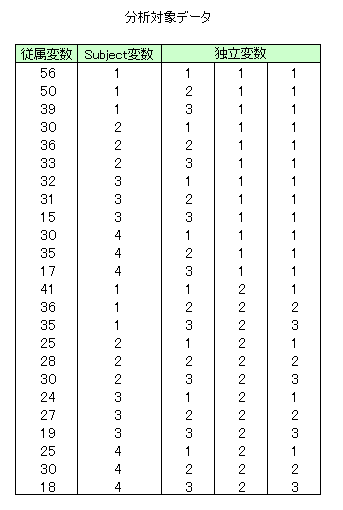
※本サンプルはnAG Cライブラリに含まれる関数 nag_reml_mixed_regsn() のExampleコードです。本サンプル及び関数の詳細情報は nag_reml_mixed_regsn のマニュアルページをご参照ください。
ご相談やお問い合わせはこちらまで
入力データ
(本関数の詳細はnag_reml_mixed_regsn のマニュアルページを参照)| このデータをダウンロード |
nag_reml_mixed_regsn (g02jac) Example Program Data
24 5 3 1 1
1 4 3 2 3
1 3 4 5 3 2 0 1 1
1
56 1 1 1 1
50 1 2 1 1
39 1 3 1 1
30 2 1 1 1
36 2 2 1 1
33 2 3 1 1
32 3 1 1 1
31 3 2 1 1
15 3 3 1 1
30 4 1 1 1
35 4 2 1 1
17 4 3 1 1
41 1 1 2 1
36 1 2 2 2
35 1 3 2 3
25 2 1 2 1
28 2 2 2 2
30 2 3 2 3
24 3 1 2 1
27 3 2 2 2
19 3 3 2 3
25 4 1 2 1
30 4 2 2 2
18 4 3 2 3
1.0 1.0
-1
- 1行目はタイトル行で読み飛ばされます。
- 2行目は観測値の数(n)、データ行列のカラム数(ncol)、固定として処理される独立変数の数(nfv)、ランダムとして処理される独立変数の数(nrv)、分散成分の数(nvpr)を指定しています。
- 3行目は各変数のレベル数(levels)を指定しています。
- 4行目は従属変数をもつデータ行列DATのカラム(yvid)、固定独立変数をもつDATのカラム(fvid)、ランダム独立変数をもつDATのカラム(rvid)、subject(個体)変数をもつDATのカラム(svid)、case weightをもつDATのカラム(cwid)、固定切片が含まれるかを示すフラグ(fint)、ランダム切片が含まれるかどうかを示すフラグ(rint)を指定しています。
- 5行目はランダム変数の分散を示すフラグ(vpr)を指定しています。
- 6~29行目はデータ行列(dat)を指定しています。
- 30行目はガンマの初期値(gamma)を指定しています
- 31行目は反復の最大値(maxit)を指定しています。ゼロより小さい場合は100が使用されます。
出力結果
(本関数の詳細はnag_reml_mixed_regsn のマニュアルページを参照)| この出力例をダウンロード |
nag_reml_mixed_regsn (g02jac) Example Program Results

Fixed effects (Estimate and Standard Deviation)

Intercept                37.0000    4.6674
Variable   1 Level   2    1.0000    3.5173
Variable   1 Level   3  -11.0000    3.5173
Variable   2 Level   2   -8.2500    2.1635
Variable   3 Level   2    0.5000    3.0596
Variable   3 Level   3    7.7500    3.0596

Random Effects (Estimate and Standard Deviation)
Intercept for Subject Level   1            10.7631    4.4865
Subject Level   1 Variable   1 Level   1    3.7276    3.0331
Subject Level   1 Variable   1 Level   2   -1.4476    3.0331
Subject Level   1 Variable   1 Level   3    0.3733    3.0331
Intercept for Subject Level   2            -0.5269    4.4865
Subject Level   2 Variable   1 Level   1   -3.7171    3.0331
Subject Level   2 Variable   1 Level   2   -1.2253    3.0331
Subject Level   2 Variable   1 Level   3    4.8125    3.0331
Intercept for Subject Level   3            -5.6450    4.4865
Subject Level   3 Variable   1 Level   1    0.5903    3.0331
Subject Level   3 Variable   1 Level   2    0.3987    3.0331
Subject Level   3 Variable   1 Level   3   -2.3806    3.0331
Intercept for Subject Level   4            -4.5912    4.4865
Subject Level   4 Variable   1 Level   1   -0.6009    3.0331
Subject Level   4 Variable   1 Level   2    2.2742    3.0331
Subject Level   4 Variable   1 Level   3   -2.8052    3.0331

 Variance Components
   1   62.3958
   2   15.3819
SIGMA^2     =     9.3611

-2LOG LIKE  =   119.7618

DF          = 16
- 3~10行目に固定効果が出力されています。
- 5行目に固定切片と標準誤差が出力されています。
- 6~10行目に固定独立変数のレベルごとにパラメータ推定と標準偏差が出力されています。
- 12~28行目にランダム効果が出力されています。
- 13行目にsubject変数のレベル1のランダム切片と標準誤差が出力されています。
- 14~16行目にランダム独立変数のレベルごとにパラメータ推定と標準偏差が出力されています。
- 17行目にsubject変数のレベル2のランダム切片と標準誤差が出力されています。
- 18~20行目にランダム独立変数のレベルごとにパラメータ推定と標準偏差が出力されています。
- 21行目にsubject変数のレベル3のランダム切片と標準誤差が出力されています。
- 22~24行目にランダム独立変数のレベルごとにパラメータ推定と標準偏差が出力されています。
- 25行目にsubject変数のレベル4のランダム切片と標準誤差が出力されています。
- 26~28行目にランダム独立変数のレベルごとにパラメータ推定と標準偏差が出力されています。
- 30~32行目に分散成分が出力されています。
- 33行目にシグマの2乗が出力されています。
- 35行目に対数尤度(log-likelihood)が出力されています。
- 37行目に自由度が出力されています。
ソースコード
(本関数の詳細はnag_reml_mixed_regsn のマニュアルページを参照)
※本サンプルソースコードはnAG数値計算ライブラリ(Windows, Linux, MAC等に対応)の関数を呼び出します。
サンプルのコンパイル及び実行方法
| このソースコードをダウンロード |
/* nag_reml_mixed_regsn (g02jac) Example Program.
 *
 * CLL6I261D/CLL6I261DL Version.
 *
 * Copyright 2017 Numerical Algorithms Group.
 *
 * Mark 26.1, 2017.
 */

#include <stdio.h>
#include <nag.h>
#include <nag_stdlib.h>
#include <nagg02.h>

int main(void)
{

  /* Scalars */
  double like, tol;
  Integer cwid, df, exit_status, fint, i, j, k, l, lb, maxit, n, ncol, nff;
  Integer nfv, nrf, nrv, nvpr, tddat, rint, svid, warnp, yvid, fnlevel;
  Integer rnlevel, lgamma, fl;
  /* Nag types */
  NagError fail;

  /* Arrays */
  double *b = 0, *dat = 0, *gamma = 0, *se = 0;
  Integer *fvid = 0, *levels = 0, *rvid = 0, *vpr = 0;

#define DAT(I, J) dat[(I-1)*tddat + J - 1]

  exit_status = 0;
  INIT_FAIL(fail);

  printf("nag_reml_mixed_regsn (g02jac) Example Program Results\n\n");

  /* Skip heading in data file */
  scanf("%*[^\n] ");

  /* Read in the problem size information */
  scanf("%ld%ld%ld%ld%ld"
        "%*[^\n] ", &n, &ncol, &nfv, &nrv, &nvpr);

  /* Check problem size */
  if (n < 0 || ncol < 0 || nfv < 0 || nrv < 0 || nvpr < 0) {
    printf("Invalid problem size, at least one of n, ncol, nfv, "
           "nrv or nvpr is < 0\n");
    exit_status = 1;
    goto END;
  }

  /* Allocate memory first lot of memory */
  if (!(levels = nAG_ALLOC(ncol, Integer)) ||
      !(fvid = nAG_ALLOC(nfv, Integer)) ||
      !(rvid = nAG_ALLOC(nrv, Integer)) || !(vpr = nAG_ALLOC(nrv, Integer)))
  {
    printf("Allocation failure\n");
    exit_status = -1;
    goto END;
  }

  /* Read in number of levels for each variable */
  for (i = 1; i <= ncol; ++i) {
    scanf("%ld", &levels[i - 1]);
  }
  scanf("%*[^\n] ");

  /* Read in model information */
  scanf("%ld", &yvid);
  for (i = 1; i <= nfv; ++i) {
    scanf("%ld", &fvid[i - 1]);
  }
  for (i = 1; i <= nrv; i++) {
    scanf("%ld", &rvid[i - 1]);
  }
  scanf("%ld%ld%ld%ld%*[^\n] ", &svid,
        &cwid, &fint, &rint);
  scanf("%*[^\n] ");

  /* Read in the variance component flag */
  for (i = 1; i <= nrv; ++i) {
    scanf("%ld", &vpr[i - 1]);
  }
  scanf("%*[^\n] ");

  /* If no subject specified, then ignore rint */
  if (svid == 0) {
    rint = 0;
  }

  /* Count the number of levels in the fixed parameters */
  for (i = 1, fnlevel = 0; i <= nfv; ++i) {
    fl = levels[fvid[i - 1] - 1] - 1;
    fnlevel += (fl < 1) ? 1 : fl;
  }
  if (fint == 1) {
    fnlevel++;
  }

  /* Count the number of levels in the random parameters */
  for (i = 1, rnlevel = 0; i <= nrv; ++i) {
    rnlevel += levels[rvid[i - 1] - 1];
  }
  if (rint) {
    rnlevel++;
  }

  /* Calculate the sizes of the output arrays */
  if (rint == 1) {
    lgamma = nvpr + 2;
  }
  else {
    lgamma = nvpr + 1;
  }
  if (svid) {
    lb = fnlevel + levels[svid - 1] * rnlevel;
  }
  else {
    lb = fnlevel + rnlevel;
  }

  tddat = ncol;

  /* Allocate remaining memory */
  if (!(dat = nAG_ALLOC(n * ncol, double)) ||
      !(gamma = nAG_ALLOC(lgamma, double)) ||
      !(b = nAG_ALLOC(lb, double)) || !(se = nAG_ALLOC(lb, double)))
  {
    printf("Allocation failure\n");
    exit_status = -1;
    goto END;
  }

  /* Read in the Data matrix */
  for (i = 1; i <= n; ++i) {
    for (j = 1; j <= ncol; ++j) {
      scanf("%lf", &DAT(i, j));
    }
  }

  /* Read in the initial values for GAMMA */
  for (i = 1; i < lgamma; ++i) {
    scanf("%lf", &gamma[i - 1]);
  }

  /* Read in the maximum number of iterations */
  scanf("%ld%*[^\n] ", &maxit);

  /* Run the analysis */
  tol = 0.;
  warnp = 0;
  /* nag_reml_mixed_regsn (g02jac).
   * Linear mixed effects regression using Restricted Maximum
   * Likelihood (REML)
   */
  nag_reml_mixed_regsn(n, ncol, dat, tddat, levels, yvid, cwid, nfv, fvid,
                       fint, nrv, rvid, nvpr, vpr, rint, svid, gamma, &nff,
                       &nrf, &df, &like, lb, b, se, maxit, tol, &warnp,
                       &fail);

  /* Report the results */
  if (fail.code == NE_NOERROR) {
    /* Output results */
    if (warnp != 0) {
      printf("Warning: At least one variance component was ");
      printf("estimated to be negative and then reset to zero");
      printf("\n");
    }
    printf("Fixed effects (Estimate and Standard Deviation)\n\n");
    k = 1;
    if (fint == 1) {
      printf("Intercept             %10.4f%10.4f\n", b[k - 1], se[k - 1]);
      ++k;
    }
    for (i = 1; i <= nfv; ++i) {
      for (j = 1; j <= levels[fvid[i - 1] - 1]; ++j) {
        if (levels[fvid[i - 1] - 1] != 1 && j == 1)
          continue;
        printf("Variable%4ld Level%4ld%10.4f%10.4f\n",
               i, j, b[k - 1], se[k - 1]);
        ++k;
      }
    }

    printf("\n");
    printf("Random Effects (Estimate and Standard Deviation)\n");
    if (svid == 0) {
      for (i = 1; i <= nrv; ++i) {
        for (j = 1; j <= levels[rvid[i - 1] - 1]; ++j) {
          printf("%s%4ld%s%4ld%10.4f%10.4f\n",
                 "Variable", i, " Level", j, b[k - 1], se[k - 1]);
          ++k;
        }
      }
    }
    else {
      for (l = 1; l <= levels[svid - 1]; ++l) {
        if (rint == 1) {
          printf("%s%4ld%s%10.4f%10.4f\n",
                 "Intercept for Subject Level", l, "         ",
                 b[k - 1], se[k - 1]);
          ++k;
        }
        for (i = 1; i <= nrv; ++i) {
          for (j = 1; j <= levels[rvid[i - 1] - 1]; ++j) {
            printf("%s%4ld%s%4ld%s%4ld"
                   "%10.4f%10.4f\n", "Subject Level", l,
                   " Variable", i, " Level", j, b[k - 1], se[k - 1]);
            ++k;
          }
        }
      }
    }

    printf("\n");
    printf("%s\n", " Variance Components");
    for (i = 1; i <= nvpr + rint; ++i) {
      printf("%4ld%10.4f\n", i, gamma[i - 1]);
    }
    printf("%s%10.4f\n\n", "SIGMA^2     = ", gamma[nvpr + rint]);

    printf("%s%10.4f\n\n", "-2LOG LIKE  = ", like);
    printf("%s%ld\n", "DF          = ", df);
  }
  else {
    printf("Routine nag_reml_mixed_regsn (g02jac) failed, with error "
           "message:\n%s\n", fail.message);
  }

END:
  nAG_FREE(b);
  nAG_FREE(dat);
  nAG_FREE(gamma);
  nAG_FREE(se);
  nAG_FREE(fvid);
  nAG_FREE(levels);
  nAG_FREE(rvid);
  nAG_FREE(vpr);
  return exit_status;
}