
Keyword: 多変量正規分布, 疑似乱数ベクトル
概要
本サンプルは多変量正規分布から疑似乱数ベクトルの生成を行うC言語によるサンプルプログラムです。 本サンプルは以下に示される確率密度関数をもつ多変量正規分布から10個の疑似乱数を生成し出力します。
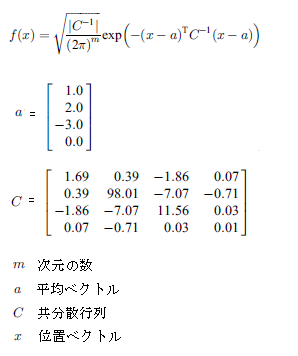
※本サンプルはnAG Cライブラリに含まれる関数 nag_rand_matrix_multi_normal() のExampleコードです。本サンプル及び関数の詳細情報は nag_rand_matrix_multi_normal のマニュアルページをご参照ください。
ご相談やお問い合わせはこちらまで
出力結果
(本関数の詳細はnag_rand_matrix_multi_normal のマニュアルページを参照)| この出力例をダウンロード |
nag_rand_matrix_multi_normal (g05rzc) Example Program Results

     1.4534  -14.1206   -3.7410    0.1184
    -0.6191   -4.8000   -0.1473   -0.0304
     1.8607    5.3206   -5.0753    0.0106
     2.0861  -13.6996   -1.3451    0.1428
    -0.6326    3.9729    0.5721   -0.0770
     0.9754   -3.8162   -4.2978    0.0040
     0.6174   -5.1573    2.5037    0.0772
     2.0352   26.9359    2.2939   -0.0826
     0.9941   14.7700   -1.0421   -0.0549
     1.5780    2.8916   -2.1725   -0.0129
- 3~12行目に生成された疑似乱数が出力されています。
ソースコード
(本関数の詳細はnag_rand_matrix_multi_normal のマニュアルページを参照)
※本サンプルソースコードはnAG数値計算ライブラリ(Windows, Linux, MAC等に対応)の関数を呼び出します。
サンプルのコンパイル及び実行方法
| このソースコードをダウンロード |
/* nag_rand_matrix_multi_normal (g05rzc) Example Program.
 *
 * CLL6I261D/CLL6I261DL Version.
 *
 * Copyright 2017 Numerical Algorithms Group.
 *
 * Mark 26.1, 2017.
 */
/* Pre-processor includes */
#include <stdio.h>
#include <math.h>
#include <nag.h>
#include <nag_stdlib.h>
#include <nagg05.h>

#define X(I, J) x[(order == Nag_ColMajor)?(J*pdx + I):(I*pdx + J)]

int main(void)
{
  /* Integer scalar and array declarations */
  Integer exit_status = 0;
  Integer i, j, lstate, lr, x_size;
  Integer *state = 0;
  Integer pdx;

  /* nAG structures */
  NagError fail;
  Nag_ModeRNG mode;

  /* Double scalar and array declarations */
  double *r = 0, *x = 0;

  /* Use column major order */
  Nag_OrderType order = Nag_RowMajor;

  /* Set the number of variables and variates */
  Integer m = 4;
  Integer n = 10;

  /* Input the covariance matrix */
  double c[] = { 1.69e0, 0.39e0, -1.86e0, 0.07e0,
    0.39e0, 98.01e0, -7.07e0, -0.71e0,
    -1.86e0, -7.07e0, 11.56e0, 0.03e0,
    0.07e0, -0.71e0, 0.03e0, 0.01e0
  };
  Integer pdc = 4;

  /* Input the means */
  double xmu[] = { 1.0e0, 2.0e0, -3.0e0, 0.0e0 };

  /* Choose the base generator */
  Nag_BaseRNG genid = Nag_Basic;
  Integer subid = 0;

  /* Set the seed */
  Integer seed[] = { 1762543 };
  Integer lseed = 1;

  /* Initialize the error structure */
  INIT_FAIL(fail);

  printf("nag_rand_matrix_multi_normal (g05rzc)"
         " Example Program Results\n\n");

  /* Get the length of the state array */
  lstate = -1;
  nag_rand_init_repeatable(genid, subid, seed, lseed, state, &lstate, &fail);
  if (fail.code != NE_NOERROR) {
    printf("Error from nag_rand_init_repeatable (g05kfc).\n%s\n",
           fail.message);
    exit_status = 1;
    goto END;
  }

  pdx = (order == Nag_ColMajor) ? n : m;
  x_size = (order == Nag_ColMajor) ? pdx * m : pdx * n;

  /* Calculate the size of the reference vector */
  lr = m * m + m + 1;

  /* Allocate arrays */
  if (!(r = nAG_ALLOC(lr, double)) ||
      !(x = nAG_ALLOC(x_size, double)) ||
      !(state = nAG_ALLOC(lstate, Integer)))
  {
    printf("Allocation failure\n");
    exit_status = -1;
    goto END;
  }

  /* Initialize the generator to a repeatable sequence */
  nag_rand_init_repeatable(genid, subid, seed, lseed, state, &lstate, &fail);
  if (fail.code != NE_NOERROR) {
    printf("Error from nag_rand_init_repeatable (g05kfc).\n%s\n",
           fail.message);
    exit_status = 1;
    goto END;
  }

  /* Set up reference vector and generate n numbers */
  mode = Nag_InitializeAndGenerate;
  nag_rand_matrix_multi_normal(order, mode, n, m, xmu,
                               c, pdc, r, lr, state, x, pdx, &fail);
  if (fail.code != NE_NOERROR) {
    printf("Error from nag_rand_matrix_multi_normal (g05rzc).\n%s\n",
           fail.message);
    exit_status = 1;
    goto END;
  }

  /* Display the variates */
  for (i = 0; i < n; i++) {
    printf("  ");
    for (j = 0; j < m; j++)
      printf("%9.4f%s", X(i, j), (j + 1) % 10 ? " " : "\n");
    if (m % 10)
      printf("\n");
  }

END:
  nAG_FREE(r);
  nAG_FREE(x);
  nAG_FREE(state);

  return exit_status;
}