
Keyword: 観測値, 割り当て, 多変量解析
概要
本サンプルは群への観測値の割り当てを行うC言語によるサンプルプログラムです。 本サンプルは以下に示されるデータについて群への観測値の割り当てを行います。
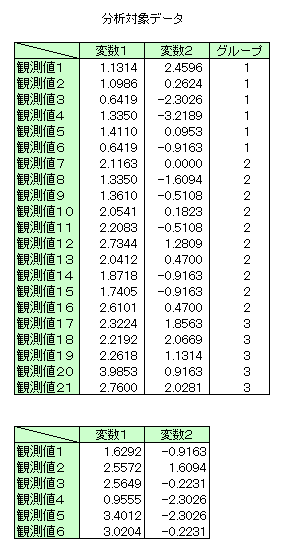
※本サンプルはnAG Cライブラリに含まれる関数 nag_mv_discrim_group() のExampleコードです。本サンプル及び関数の詳細情報は nag_mv_discrim_group のマニュアルページをご参照ください。
ご相談やお問い合わせはこちらまで
入力データ
(本関数の詳細はnag_mv_discrim_group のマニュアルページを参照)| このデータをダウンロード |
nag_mv_discrim_group (g03dcc) Example Program Data
  21 2 2 3 Nag_FALSE
  1.1314    2.4596    1
  1.0986    0.2624    1
  0.6419   -2.3026    1
  1.3350   -3.2189    1
  1.4110    0.0953    1
  0.6419   -0.9163    1
  2.1163    0.0000    2
  1.3350   -1.6094    2
  1.3610   -0.5108    2
  2.0541    0.1823    2
  2.2083   -0.5108    2
  2.7344    1.2809    2
  2.0412    0.4700    2
  1.8718   -0.9163    2
  1.7405   -0.9163    2
  2.6101    0.4700    2
  2.3224    1.8563    3
  2.2192    2.0669    3
  2.2618    1.1314    3
  3.9853    0.9163    3
  2.7600    2.0281    3
   1         1
   6 Nag_NotEqualCovar Nag_DiscrimPredict
  1.6292   -0.9163
  2.5572    1.6094
  2.5649   -0.2231
  0.9555   -2.3026
  3.4012   -2.3026
  3.0204   -0.2231
- 1行目はタイトル行で読み飛ばされます。
- 2行目に観測値の数(n)、変数の数(m)、分散共分散行列の変数の数(nvar)、グループの数(ng)、重みづけをするかどうか(weight)を指定しています。 "Nag_FALSE"は重みづけをしないことを意味します。
- 3~23行目に変数の観測値(x)と観測値がどのグループに属するか(ing)を指定しています。
- 24行目に変数が距離計算に含まれるかどうか(isx)を指定しています。"1"の場合は計算に含まれます。
- 25行目に割り当てられる観測値の数(nobs)、グループ内の分散共分散行列が等しいと仮定されるかどうかを示すパラメータ(equal)、推定アプローチか予測アプローチのどちらが使用されるかを示すパラメータ(type)を指定しています。"Nag_NotEqualCovar "はグループ内の分散共分散行列が等しくないことを意味します。 "Nag_DiscrimPredict"は予測アプローチを意味します。
- 26~31行目に変数の新たな観測値(x)を指定しています。
出力結果
(本関数の詳細はnag_mv_discrim_group のマニュアルページを参照)| この出力例をダウンロード |
nag_mv_discrim_group (g03dcc) Example Program Results


    Obs       Posterior        Allocated       Atypicality
              probabilities    to group      index

      1      0.094 0.905 0.002       2     0.596 0.254 0.975
      2      0.005 0.168 0.827       3     0.952 0.836 0.018
      3      0.019 0.920 0.062       2     0.954 0.797 0.912
      4      0.697 0.303 0.000       1     0.207 0.860 0.993
      5      0.317 0.013 0.670       3     0.991 1.000 0.984
      6      0.032 0.366 0.601       3     0.981 0.978 0.887
- 4~12行目に何番目の観測値か、グループへの観測値の割り当てに対する事後確率、観測値が割り当てられたグループ、グループに対する観測値の不適合度が出力されています。5番目と6番目の観測値は3つのグループのどれにもあまり適合していないことがわかります。
ソースコード
(本関数の詳細はnag_mv_discrim_group のマニュアルページを参照)
※本サンプルソースコードはnAG数値計算ライブラリ(Windows, Linux, MAC等に対応)の関数を呼び出します。
サンプルのコンパイル及び実行方法
| このソースコードをダウンロード |
/* nag_mv_discrim_group (g03dcc) Example Program.
 *
 * CLL6I261D/CLL6I261DL Version.
 *
 * Copyright 2017 Numerical Algorithms Group.
 *
 * Mark 26.1, 2017.
 *
 */

#include <nag.h>
#include <stdio.h>
#include <nag_stdlib.h>
#include <nagg03.h>

#define ATI(I, J)   ati[(I) *tdati + J]
#define P(I, J)     p[(I) *tdp + J]
#define X(I, J)     x[(I) *tdx + J]

int main(void)
{
  Integer exit_status = 0, i, *iag = 0, *ing = 0, *isx = 0, j, m, n,
         ng, *nig = 0, nobs;
  Integer nvar, tdati, tdgmean, tdp, tdx;
  double *ati = 0, *det = 0, df, *gc = 0, *gmean = 0, *p = 0;
  double *prior = 0, sig, stat, *wt = 0, *wtptr = 0, *x = 0;
  char nag_enum_arg[40];
  Nag_Boolean atiq = Nag_TRUE, weight;
  Nag_DiscrimMethod type;
  Nag_GroupCovars equal;
  NagError fail;

  INIT_FAIL(fail);

  printf("nag_mv_discrim_group (g03dcc) Example Program Results\n\n");

  /* Skip headings in data file */
  scanf("%*[^\n]");

  scanf("%ld", &n);
  scanf("%ld", &m);
  scanf("%ld", &nvar);
  scanf("%ld", &ng);
  scanf("%39s", nag_enum_arg);
  /* nag_enum_name_to_value (x04nac).
   * Converts nAG enum member name to value
   */
  weight = (Nag_Boolean) nag_enum_name_to_value(nag_enum_arg);

  if (n >= 1 && nvar >= 1 && m >= nvar && ng >= 2) {
    if (!(det = nAG_ALLOC(ng, double)) ||
        !(gc = nAG_ALLOC((ng + 1) * nvar * (nvar + 1) / 2, double)) ||
        !(gmean = nAG_ALLOC((ng) * (nvar), double)) ||
        !(prior = nAG_ALLOC(ng, double)) ||
        !(wt = nAG_ALLOC(n, double)) ||
        !(x = nAG_ALLOC((n) * (m), double)) ||
        !(ing = nAG_ALLOC(n, Integer)) ||
        !(isx = nAG_ALLOC(m, Integer)) || !(nig = nAG_ALLOC(ng, Integer)))
    {
      printf("Allocation failure\n");
      exit_status = -1;
      goto END;
    }
    tdgmean = nvar;
    tdx = m;
  }
  else {
    printf("Invalid n or nvar or ng.\n");
    exit_status = 1;
    return exit_status;
  }
  if (weight) {
    for (i = 0; i < n; ++i) {
      for (j = 0; j < m; ++j)
        scanf("%lf", &X(i, j));
      scanf("%ld", &ing[i]);
      scanf("%lf", &wt[i]);
    }
    wtptr = wt;
  }
  else {
    for (i = 0; i < n; ++i) {
      for (j = 0; j < m; ++j)
        scanf("%lf", &X(i, j));
      scanf("%ld", &ing[i]);
    }
  }
  for (j = 0; j < m; ++j)
    scanf("%ld", &isx[j]);

  /* nag_mv_discrim (g03dac).
   * Test for equality of within-group covariance matrices
   */
  nag_mv_discrim(n, m, x, tdx, isx, nvar, ing, ng, wtptr, nig,
                 gmean, tdgmean, det, gc, &stat, &df, &sig, &fail);
  if (fail.code != NE_NOERROR) {
    printf("Error from nag_mv_discrim (g03dac).\n%s\n", fail.message);
    exit_status = 1;
    goto END;
  }
  scanf("%ld", &nobs);
  scanf("%39s", nag_enum_arg);
  equal = (Nag_GroupCovars) nag_enum_name_to_value(nag_enum_arg);
  scanf("%39s", nag_enum_arg);
  type = (Nag_DiscrimMethod) nag_enum_name_to_value(nag_enum_arg);
  if (nobs >= 1) {
    if (!(ati = nAG_ALLOC((nobs) * (ng), double)) ||
        !(p = nAG_ALLOC((nobs) * (ng), double)) ||
        !(iag = nAG_ALLOC(nobs, Integer)))
    {
      printf("Allocation failure\n");
      exit_status = -1;
      goto END;
    }
    tdati = ng;
    tdp = ng;
    for (i = 0; i < nobs; ++i) {
      for (j = 0; j < m; ++j) {
        scanf("%lf", &X(i, j));
      }
    }

    /* nag_mv_discrim_group (g03dcc).
     * Allocates observations to groups, following
     * nag_mv_discrim (g03dac)
     */
    nag_mv_discrim_group(type, equal, Nag_EqualPrior, nvar, ng, nig, gmean,
                         tdgmean, gc, det, nobs, m, isx, x, tdx, prior, p,
                         tdp, iag, atiq, ati, &fail);
    if (fail.code != NE_NOERROR) {
      printf("Error from nag_mv_discrim_group (g03dcc).\n%s\n", fail.message);
      exit_status = 1;
      goto END;
    }

    printf("\n");
    printf("    Obs       Posterior        Allocated ");
    printf("      Atypicality ");
    printf("\n");
    printf("              probabilities    to group      index ");
    printf("\n");
    printf("\n");
    for (i = 0; i < nobs; ++i) {
      printf(" %6ld     ", i + 1);
      for (j = 0; j < ng; ++j) {
        printf("%6.3f", P(i, j));
      }
      printf("  %6ld    ", iag[i]);
      for (j = 0; j < ng; ++j) {
        printf("%6.3f", ATI(i, j));
      }
      printf("\n");
    }
  }

END:
  nAG_FREE(ati);
  nAG_FREE(det);
  nAG_FREE(gc);
  nAG_FREE(gmean);
  nAG_FREE(p);
  nAG_FREE(prior);
  nAG_FREE(wt);
  nAG_FREE(x);
  nAG_FREE(iag);
  nAG_FREE(ing);
  nAG_FREE(isx);
  nAG_FREE(nig);
  return exit_status;
}