


s20ad returns a value for the Fresnel Integral C x
 Syntax
| C# |
|---|
public static double s20ad( double x ) |
| Visual Basic (Declaration) |
|---|
Public Shared Function s20ad ( _ x As Double _ ) As Double |
| Visual C++ |
|---|
public: static double s20ad( double x ) |
| F# |
|---|
static member s20ad : x:float -> float |
Parameters
- x
- Type: System..::.Double
On entry: the argument
Return Value
s20ad returns a value for the Fresnel Integral C x
Description
s20ad evaluates an approximation to the Fresnel Integral
Note: C x = - C - x x ≥ 0.0
The method is based on three Chebyshev expansions:
For 0 < x ≤ 3
For x > 3
where f x = ∑ ' r = 0 b r T r t
and g x = ∑ ' r = 0 c r T r t
with t = 2
3 x 4 - 1
For small x C x ≃ x x
For large x f x ≃
1 π
g x ≃
1 π 2
x
1 π 2 x 3
is negligible compared with
1 2
, the second term in the approximation for x > 3 x
1 π x
becomes negligible, C x ≃
1 2
sin
π 2 x 2 sin
π 2 x 2 x 2 x 2 = N + θ N 0 ≤ θ < 1 sin
π 2 x 2 θ N 4 sin
π 2 x 2 x
x 2
is equal to the maximum integer allowed on the machine.
References
Error Indicators and Warnings
There are no failure exits from s20ad.
Accuracy
Let δ ε
If δ δ ε δ
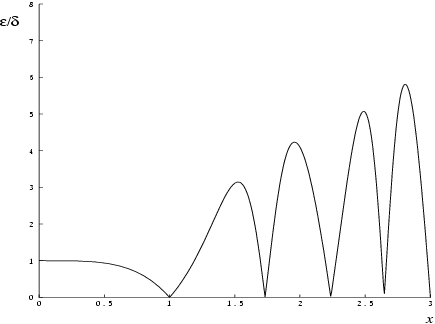
Figure 1 shows the behaviour of the error amplification factor
x
cos
π 2
x 2
C x
.
However, if δ ε
For small x ε ≃ δ
For moderately large values of x
and the result will be subject to increasingly large amplification of errors. However the above relation breaks down for large values of x
1 x 2
is of the order of the machine precision); in this region the relative error in the result is essentially bounded by
2 π x
.
Hence the effects of error amplification are limited and at worst the relative error loss should not exceed half the possible number of significant figures.
Further Comments
None.
Example
This example reads values of the argument x x
Example program (C#): s20ade.cs
